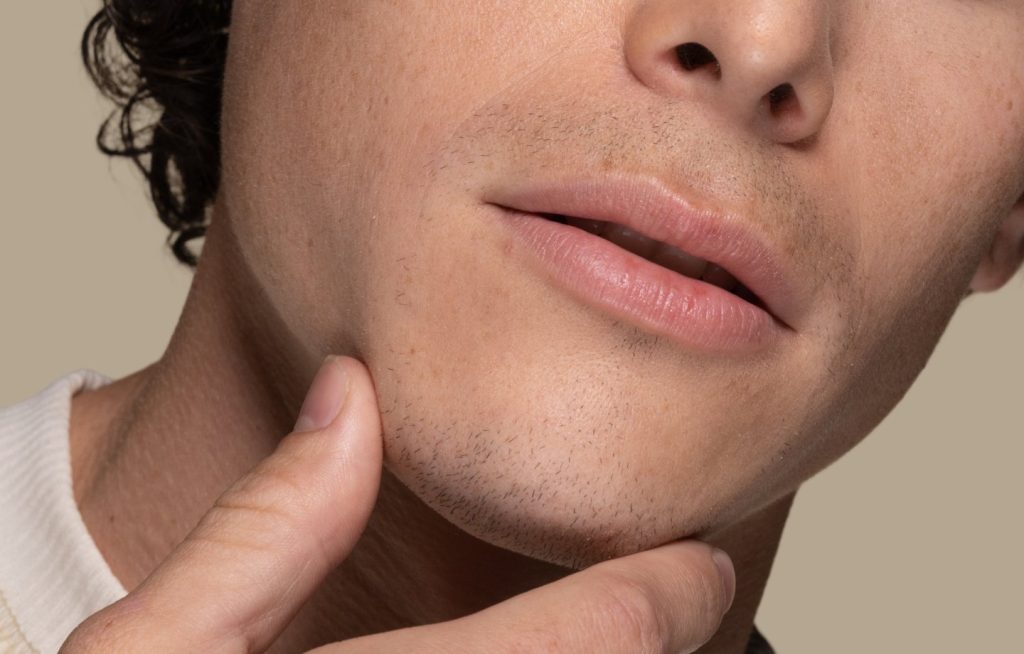






Botulinum toxin works on the muscle, hyaluronic acid on volume. Before you choose a product, it is worth recognising what actually creates the wrinkle you see.
The question usually goes like this: I have a wrinkle and I want to get rid of it, I just don’t know whether it is a job for botulinum toxin or for hyaluronic acid. Asked this way it has no good answer, because the product is not matched to the wrinkle but to the mechanism that caused it. Botulinum toxin and a hyaluronic acid filler do two different things, and neither replaces the other. Chosen wrongly, each will work according to its own mechanism, just not where the problem lies.
Two different mechanisms, not two versions of the same thing
Botulinum toxin is an injectable medicine that temporarily limits the transmission of the signal from nerve to muscle. The muscle contracts more weakly, so the skin above it stops creasing in the same place with every movement of the face. Cross-linked hyaluronic acid does not touch the muscle: it fills the area where tissue has been lost and rebuilds the support on which the skin rests.
The consequence is simple. Toxin will not add volume to a flattened cheek, and a filler will not stop a muscle that pulls the forehead every time you raise your eyebrows. Botulinum toxin is a prescription medicine, a filler is a medical device; in both cases the doctor decides on eligibility and the amount of product, not a photo brought to the appointment. Beyond that they have little in common.
Expression lines and static wrinkles: the mirror test
The distinction that every such conversation starts with is made in front of a mirror and takes a minute.
- Relax your face, look straight ahead and remember what you see.
- Raise your eyebrows, frown, smile widely, squint.
- Return to rest and compare the two images.
A line that appears only with movement and disappears when the face relaxes is an expression line: its source is the work of the muscle. A fold that is also visible when the face is still is static: the skin there has a set crease, or volume is missing underneath. The most common, though, is a third variant, in which the same area has both features at once, because years of muscle work have left a mark that no longer goes away. Then the “either-or” question stops being the right one and the plan is set out in stages: first whatever causes the wrinkle to form, then an assessment of how much of it remains.
When the answer is botulinum toxin
The most common areas are horizontal forehead lines, the frown line between the eyebrows and crow’s feet. Less often we work on smaller areas: a gummy smile, drooping corners of the mouth, a dimpled chin. A separate indication, close to a dental practice, is reducing tension in the masseter muscles in people who clench their teeth: it reduces the force of clenching, but does not remove the cause of bruxism. Underarm hyperhidrosis has nothing to do with the face at all. Neither of these is an aesthetic indication, and each is charged separately.
- The visit, including a medical history and an assessment of facial expression in motion, fits into 20–30 minutes
- The first effect is visible after 3–7 days, so how you look in the first days is not treated as the result
- The full effect is assessed after two weeks: that is when we plan the follow-up and, if needed, a top-up dose
- The effect is temporary: usually 3–6 months, depending on the area, the dose and the strength of the muscle
An important limitation: wrinkles that are also visible when the face is still fade only partly after toxin. The muscle stops deepening the crease, but whatever the skin has already set remains. That is why, for someone who comes in with a fold present at rest, toxin alone can be a disappointment, and it is better to say so before the injection than after it.
When the answer is hyaluronic acid
A filler comes into play when the problem is not movement but a lack of support. Hyaluronic acid volumetry most often covers the cheeks, the nasolabial folds and the jawline. It does not tighten the skin or remove its excess: it rebuilds the volume on which the skin rests. A session takes about 45 minutes, and the result is assessed once the swelling has gone down, usually after two weeks. The product is gradually absorbed over 6–12 months, faster in parts of the face that move a lot.
- The face looks tired even when rested, and the upper part of the cheek has clearly flattened
- The nasolabial folds are visible even when the face is still
- The facial contour is blurring and the jawline is no longer clearly defined
- After significant weight loss, the face has lost volume faster than the rest of the body
There is also the opposite situation, in which a filler makes the whole face look worse. If the change comes from an excess of sagging skin rather than a loss of volume, adding material underneath deepens the impression of heaviness instead of reducing it. Volumetry does not replace surgery and does not treat excess skin, which is why assessment starts with the proportions of the whole face, at rest and in motion, not with the single fold pointed out with a finger.
“A wrinkle is a symptom, not a diagnosis.
Smile Bonding Studio · the principle we start every consultation with
The question is whether a muscle made it, or a lack of volume under the skin.”
Mesotherapy is a third category, not a kind of filler
This is the most common misunderstanding in this conversation, and it comes from the name of the ingredient. Needle mesotherapy also uses hyaluronic acid, but in non-cross-linked form, in a cocktail with amino acids and vitamins, through a series of shallow injections into the dermis. Such a product is not meant to stay in one place and does not build volume. It works on the hydration, tone and firmness of the skin.
Mesotherapy will not fill a fold or relax a muscle. It makes sense for someone whose skin is dehydrated, dull and losing elasticity while the face keeps its volume, and also as a first step for someone who wants to improve the condition of their skin before deciding on treatments that change their features. One session takes 30–45 minutes, and the full protocol is usually four treatments a few weeks apart. It is a course, not a single appointment, and it needs to be planned that way.
Your first aesthetic medicine treatment: how we handle it
We have offered aesthetic medicine since May 2026, in a treatment room, and assessment and administration of the product are solely the doctor’s responsibility. Before the first filler treatment a consultation is mandatory: a medical history covering general conditions, medicines and previous treatments, an assessment of the face at rest and in motion, and a plan of the areas with costs and alternatives. Without it we do not book a treatment date. With botulinum toxin, the same scope of assessment takes place at the treatment visit, before the first injection.
- At the first visit we stay below the target amount: too little can be topped up at the next appointment, too much cannot be reversed as easily
- The follow-up after two weeks is part of the plan, not a reaction to a problem: only then can the result be seen without swelling
- One thing at a time: we spread combined treatments across separate appointments, so we know which one produced which effect
- Tell us about previous fillers and threads: what was given and when matters
- Book well ahead of an important event, because swelling and bruising need a few days
When the answer is “not now”
Some consultations end without a date being set, and that is a normal outcome, not a failed visit. We do not give toxin during pregnancy or breastfeeding, with neuromuscular diseases, with an infection or inflammation at the injection site, or with hypersensitivity to the product. We decline a filler with an infection in the treatment area, clotting disorders, during pregnancy and while breastfeeding. Autoimmune diseases and medicines you take are assessed individually in the medical history.
Sometimes there are no contraindications, and yet we suggest waiting or starting with something else. If the shape of the smile changes because of how the teeth are positioned, no product will improve it, and we start with dental diagnostics. If the expectation from a photo you bring in really concerns a different facial structure, we say so plainly, instead of injecting material and hoping it works out. A postponed decision rules nothing out. Too much product in the face means several months of waiting for it to be absorbed.

Start with a consultation